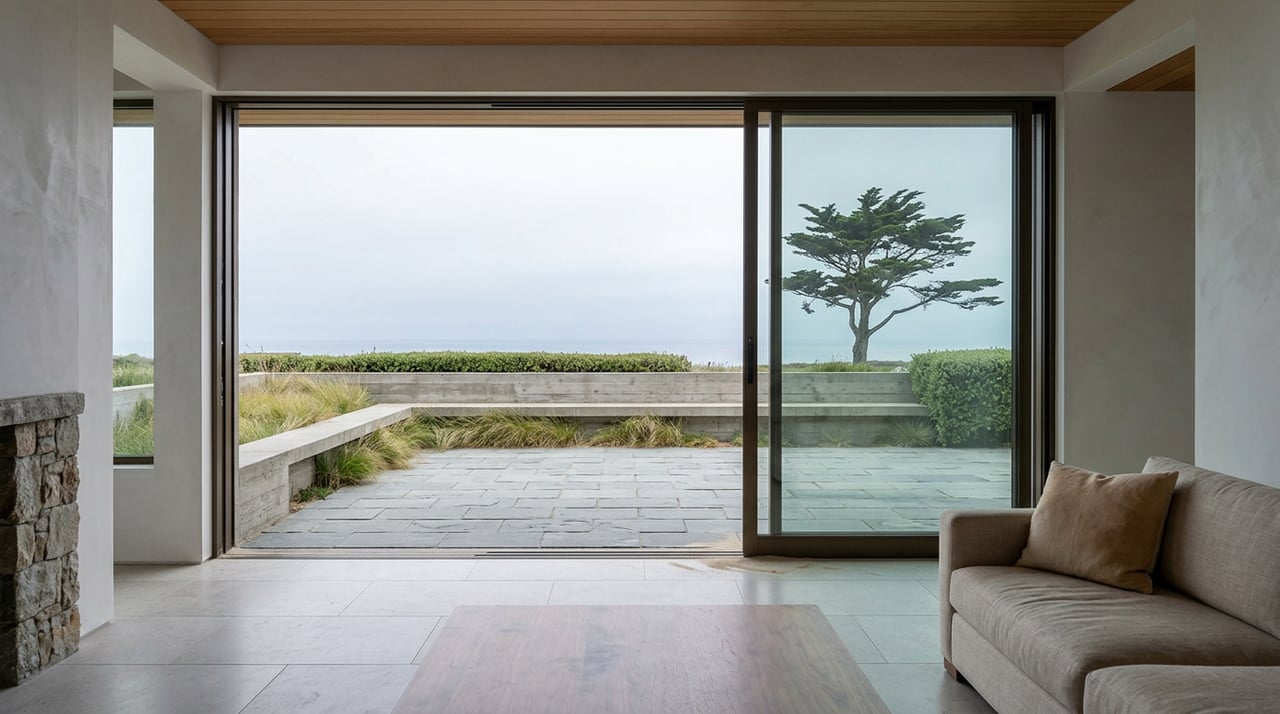
Bodega Bay's Cash Buyers Aren't Winning a Bidding War. There Isn't One.
September 17, 2026
September 17, 2026
A financed buyer touring Bodega Bay this year might reasonably expect competition. The town has ocean views, a working harbor, whale season traffic, and a housing stock small enough that a handful of sales can swing the median. That combination usually means bidding wars. In March 2026, it meant something closer to the opposite: Bodega Bay recorded zero multiple-offer transactions, the same as Guerneville and The Sea Ranch, while two out of every three closings in town were paid in cash.
That pairing does not read the way it should. A market with a two-thirds cash share usually looks hot, the kind of place where a financed offer gets outbid by a buyer who can skip the appraisal and close in three weeks. Bodega Bay had the cash share without the competition. Understanding why matters more to a financed buyer here than any single price data point, because the obstacle in this market isn't outbidding a rival offer. It's getting insured fast enough to make one at all.
Countywide in March 2026, Sonoma closings split close to what you'd expect for a normal market: 73.8 percent financed, 26.2 percent cash. Santa Rosa, the county's highest-volume market with 96 closings that month, was the most loan-dependent of all at just 16.7 percent cash.
Bodega Bay sat at the other end, with 66.7 percent of closings paid in cash, trailing only Glen Ellen at 75 percent and running ahead of The Sea Ranch at 62.5 percent. In a typical seller's market, that kind of cash concentration would mean financed buyers were consistently losing out to stronger offers. But losing a bidding war requires a bidding war. Bodega Bay didn't have one. The zero-multiple-offer figure means sellers in town were, on average, working with a single offer at a time, not choosing between several.
So the cash isn't beating anyone. It's simply what's left standing once a large share of would-be financed buyers self-select out before an offer ever gets written.
The most likely explanation sits with insurance, not appetite. Homeowners insurance in coastal and wildfire-adjacent California has tightened sharply, and the California FAIR Plan, the state's insurer of last resort, is raising rates by an average of 29.1 percent starting October 15, 2026, according to reporting from KQED. That is the steepest single increase in the plan's history, and it lands on a pool of homes that has nearly tripled as a share of the state's housing stock over the past several years, as standard carriers pull back from areas they consider harder to underwrite.
For a cash buyer, an insurance delay is an inconvenience. For a financed buyer, it can be a closing that doesn't happen. Lenders require a bindable insurance policy before funding, and if a coastal property can't get a standard-market quote quickly and has to route through FAIR Plan underwriting instead, that process can eat into a loan contingency window before the buyer even gets an answer. A cash offer doesn't wait on that clock. A financed offer does, and in a town where inventory is thin enough that sellers often only have one offer on the table, a financed buyer who stalls in underwriting isn't losing a bidding war. They're simply not there anymore by the time the seller needs an answer.
Part of what makes Bodega Bay's insurance picture more complicated than a typical Sonoma County listing is geology, not just fire exposure. Bodega Head sits directly alongside a strand of the San Andreas Fault, which runs just east of the headland and through the bay itself before continuing offshore, according to mapping documented by the U.S. Geological Survey. This isn't the generic "earthquake country" framing that applies to most of coastal California. It's a specific, mapped strand of the state's most studied fault system running through the town's own peninsula.
Earthquake coverage in California is sold separately from a standard homeowners policy, typically through the California Earthquake Authority, and statewide only about 10 to 13 percent of homeowners currently carry it. That's a national quirk, not a Bodega Bay one, but it means a financed buyer here is making a real decision about earthquake coverage in a location where the fault isn't an abstraction on a hazard map, it's the ridge the town is built against. Working through that decision, on top of a FAIR Plan quote for fire exposure, adds real time to a purchase that a cash buyer simply doesn't have to spend.
None of this happened overnight. Bodega Bay's residential market has long skewed toward second-home ownership, with local sales data putting the second-home share of buyers at roughly 85 percent, most coming from the greater San Francisco Bay Area and the Sacramento Valley. A buyer purchasing a second home is frequently drawing on equity or investment proceeds rather than a primary mortgage, which naturally pushes the cash share higher than in a primary-residence market like Santa Rosa or Windsor.
That structural pattern and the current insurance friction reinforce each other. A market already tilted toward cash buyers, layered with a hard insurance market that specifically slows down financed transactions, produces exactly the pattern the March data shows: high cash share, no competing offers, and financed buyers who either aren't showing up or aren't closing when they do.
If you're planning to finance a home in Bodega Bay, the smartest move is to treat insurance as part of your offer strategy, not paperwork you handle after acceptance. A few things worth doing before you write:
None of this means financing is a bad idea here. It means the timeline matters more than the price, and a buyer who lines up financing and insurability in parallel, rather than sequentially, is the one who actually gets to make an offer instead of watching a cash buyer close first.
Does the fault line itself raise my insurance premium? Not directly. Earthquake coverage is priced separately from fire insurance, and California Earthquake Authority premiums are based on building type, location, and deductible rather than proximity to a mapped fault line alone. But being near a documented, active strand means the earthquake coverage conversation isn't optional in the way it might be elsewhere in the county.
Is Bodega Harbour easier to insure than the more remote parts of town? It can be, since planned communities with defined building standards and closer fire department access sometimes present a more straightforward underwriting picture than isolated parcels further up the coast. That said, every carrier prices differently, and the only way to know for a specific address is to get a quote.
If cash buyers dominate this market, should I stop trying to finance? Not necessarily. The data shows cash isn't outcompeting financed offers here, it's filling a gap left by buyers who didn't get their insurance and financing lined up in time. A financed buyer who does that groundwork early is competing against far less than the headline cash percentage suggests.
Bodega Bay rewards buyers who treat the insurance conversation as the first step, not the last one. If you're weighing a purchase on the Sonoma Coast and want a clear read on what financing actually looks like for a specific property, from loan structuring through the insurance binder your lender will require, Austin Canum can walk through it with you. Let's Connect.
Stay up to date on the latest real estate trends.
With over 20 years of experience in real estate and mortgage lending, Austin delivers personalized guidance, skilled negotiation, and exceptional service tailored to your goals. Whether you're buying, selling, or financing, you can count on a seamless experience built on trust, communication, and proven expertise.

AUSTIN CANUM REAL ESTATE
Austin Canum | CA DRE #01452415
[email protected]
(707) 548-7659
ADDRESS 2293 W Hearn Ave Santa Rosa, CA 95407