In Kenwood, the County Won Its Well Case. Buyers Should Pay Attention to What It Lost.
September 24, 2026
September 24, 2026
"We also express no opinion as to the manner in which CEQA should be complied with or whether any moratorium or intervening measures concerning non-emergency well permits are appropriate."
That sentence sits in a footnote near the end of a California appellate ruling handed down this August. It reads like routine judicial hedging. For anyone buying acreage on a private well in Kenwood right now, it is closer to the actual headline.
On August 4, 2026, California's First District Court of Appeal ruled on a long-running fight over Sonoma County's groundwater well ordinance. The county won the part that made news. It lost the part that matters more to buyers, and the loss is the reason the rules governing wells in Kenwood are settled for the moment but not settled for good.
The case, Russian Riverkeeper v. County of Sonoma, traces back to a 2021 lawsuit that forced the county to weigh the public trust doctrine, essentially its duty to protect navigable waterways, when approving new well permits. That settlement led to a six-month moratorium on well permitting in 2022 while the county rewrote its ordinance. The rewritten rules took effect in May 2023. Two nonprofits, Russian Riverkeeper and California Coastkeeper Alliance, sued again a month later, arguing the new ordinance still failed the public trust doctrine and had wrongly skipped environmental review under the California Environmental Quality Act.
In August 2024, a Sonoma County Superior Court judge agreed with the nonprofits on both counts and ordered the county to stop issuing non-emergency well permits. That order landed on the county in December 2024. The Court of Appeal granted a stay in March 2025 that let Permit Sonoma keep issuing permits while the appeal played out.
The August 2026 decision split the difference. The appellate panel found the county's ordinance did not violate the public trust doctrine, a win county officials had been fighting for since 2021. But it agreed with the lower court that the county lacked the evidence to claim its ordinance was exempt from CEQA review, and it sent the case back to Sonoma County Superior Court, now overseen by Judge Jane Gaskell following Judge Bradford DeMeo's retirement. Sean Bothwell of California Coastkeeper Alliance told reporters the decision now applies statewide. County officials have said a full environmental review could take years and cost hundreds of thousands of dollars.
For a Kenwood buyer, the practical read is this: the ordinance stands today, and permits are being issued today, but the process that determines tomorrow's rules is now legally required rather than optional. If you are counting on drilling a new well, deepening an existing one, or adding a second unit that needs its own water source, you are relying on a system the courts have explicitly declined to guarantee will look the same in a year.
Kenwood does not have a single water story. It has two, and which one applies to a given property depends on an address, not a price point.
A small service area covering Kenwood Village and the Kenwood Inn is supplied by Kenwood Village Water Company, a CPUC-regulated utility that draws from two company-maintained wells. Buyers inside that footprint are dealing with a licensed water utility, not a private well, and their due diligence looks more like checking a utility's rate schedule than commissioning a yield test.
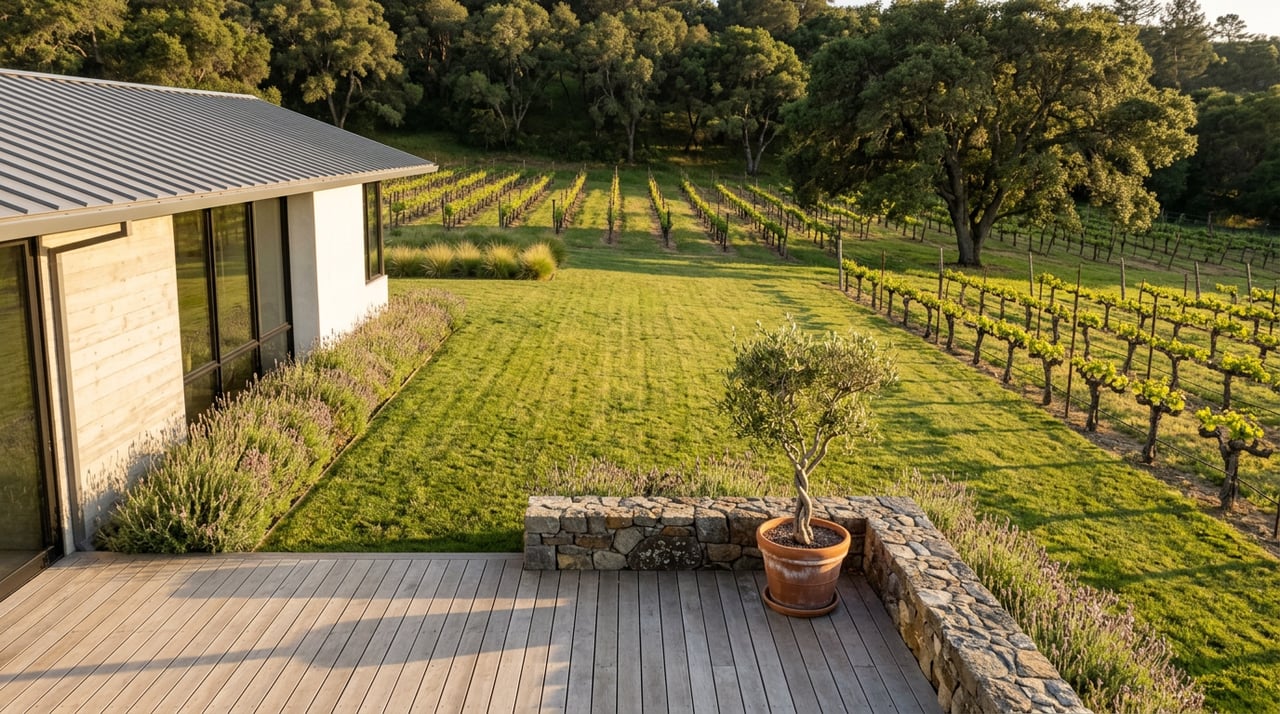
Almost everything outside that small pocket, the hillside parcels, the vineyard acreage, the estate properties that make up most of what a Wine Country buyer is actually shopping for in Kenwood, sits on an individual private well subject to the county ordinance described above. That well was permitted under a specific set of rules at a specific point in time, and its future maintenance, replacement, or expansion runs through Permit Sonoma's current process, the one now facing a court-ordered environmental review.
Before writing an offer on a Kenwood property, it is worth confirming which of these two systems actually serves the parcel. A listing that says "well" does not tell you whether that well sits inside the regulated basin the county and state track, or whether it is old enough to predate current permitting standards altogether.
There is a second line worth knowing, and it runs underground.
The Sonoma Valley Groundwater Sustainability Agency describes its basin as running from just south of Kenwood down to San Pablo Bay. That framing matters because Kenwood effectively marks the top of this groundwater system, the point where the basin begins rather than where problems have concentrated.
In May 2025, the agency designated two new Groundwater Sustainability Priority Areas within that basin, El Verano and the Eastside, after data showed deep aquifers below 200 feet declining by as much as eight feet a year in the worst-affected zones, with some areas down nearly 100 feet over the last decade. Marcus Trotta, the principal hydrogeologist at Sonoma Water who manages the plan for the agency, called it "a decades-in-the-making issue that no single solution or agency can fix alone." District 1 Supervisor Rebecca Hermosillo, who vice-chairs the agency's board, has framed the response as a community-wide effort rather than a top-down mandate.
None of this means a Kenwood well is in trouble. It means Kenwood sits at the head of a basin where the state has just drawn new lines around problem areas downstream, and groundwater systems do not respect city limits or price brackets. A property at the north end of the basin draws from the same connected aquifer system the state is now watching closely at the south end.
The financial exposure for an individual homeowner is smaller than the headlines suggest. The agency's adopted 2025-2026 fee structure works out to roughly 22 dollars a year for a typical rural residential well using about half an acre-foot annually, a rounding error against any escrow line item. The real pressure in this basin falls on high-volume agricultural and commercial users, not single-family wells. That is useful context, but it does not change the underlying due-diligence question: does this specific parcel sit inside the mapped basin, and if so, is it anywhere near the priority designations the agency is watching.
Financing a property on a private well means different loan programs ask for different proof, and the gap between them is wider than most buyers expect.
That last point is the one self-employed and jumbo borrowers should sit with. A conventional or jumbo lender may not require a water test up front, but an appraiser working a Kenwood estate property, especially one they know sits near a priority area, may ask for one anyway. If that request surfaces two weeks before closing, it can stall a purchase that was otherwise ready to fund. Building a water quality and yield test into the offer timeline from the start, rather than waiting for an appraiser to request one, keeps a financing schedule intact.
None of this should discourage anyone from buying in Kenwood. Wells fail underwriting far less often than buyers fear, and the county's ordinance, whatever its legal future, is still functioning today. What it does argue for is asking two specific questions before you write an offer rather than during your contingency period: which water system actually serves this parcel, and does it sit inside the mapped Sonoma Valley basin near either of the newly designated priority areas.
Those answers shape everything from your inspection checklist to how much slack you build into a jumbo or bank-statement loan timeline. That is exactly where coordinating the property search and the financing plan through one advisor earns its keep, since a due-diligence question that touches both the deed and the loan file is easy to lose between an agent and a lender who are not talking to each other.
Does the August 2026 ruling mean Sonoma County has stopped issuing well permits? No. The ordinance remains in effect and the county continues processing permits. The ruling orders a new environmental review of how the ordinance was adopted, a process that runs alongside normal permitting rather than replacing it immediately.
If I buy a Kenwood property with an existing, already-permitted well, does any of this affect me? Existing wells in normal residential use are not the focus of this fight. The exposure is concentrated in new permits, well replacements, and higher-volume uses, which is where both the court case and the groundwater agency's attention are pointed.
How do I find out if a specific Kenwood parcel sits inside the Sonoma Valley groundwater basin or a priority area? Permit Sonoma's records and the Sonoma Valley Groundwater Sustainability Agency's public maps can confirm both. It is a five-minute check worth doing before you write an offer, not after.
Kenwood's water story is more layered than a listing sheet will ever show you, and that is precisely the kind of detail worth sorting out before you are three weeks into escrow. If you are evaluating a property here and want someone who can walk the parcel, the permit history, and the loan file at the same time, Austin Canum is glad to help. Let's Connect.
Stay up to date on the latest real estate trends.
With over 20 years of experience in real estate and mortgage lending, Austin delivers personalized guidance, skilled negotiation, and exceptional service tailored to your goals. Whether you're buying, selling, or financing, you can count on a seamless experience built on trust, communication, and proven expertise.

AUSTIN CANUM REAL ESTATE
Austin Canum | CA DRE #01452415
[email protected]
(707) 548-7659
ADDRESS 2293 W Hearn Ave Santa Rosa, CA 95407